Showing posts with label Louis Sullivan. Show all posts

8/22/14

CHARNLEY PERSKY HOUSE DAMAGED BY STORM / FLOODING

CHARNLEY PERSKY HOUSE DAMAGED BY STORM / FLOODING: HELP NEEDED

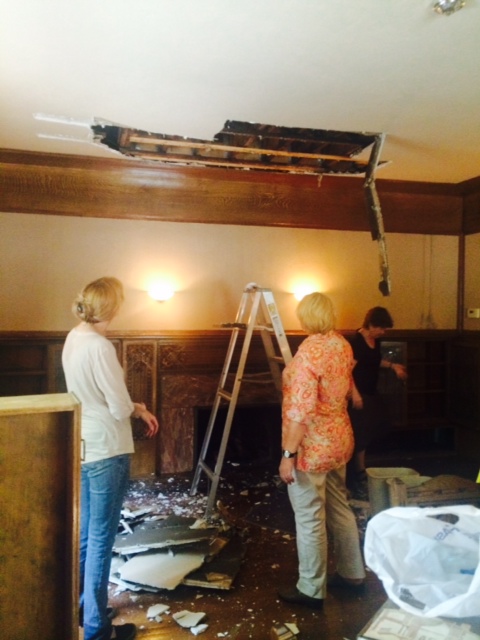
Charnley-Persky House experienced serious flooding on Tuesday afternoon. Water poured in through the sink and toilet of the second-floor powder room, on the north side of the house. The water flooded the room and traveled down through the ceiling and walls to the living room library on the first floor and continued on to the basement.


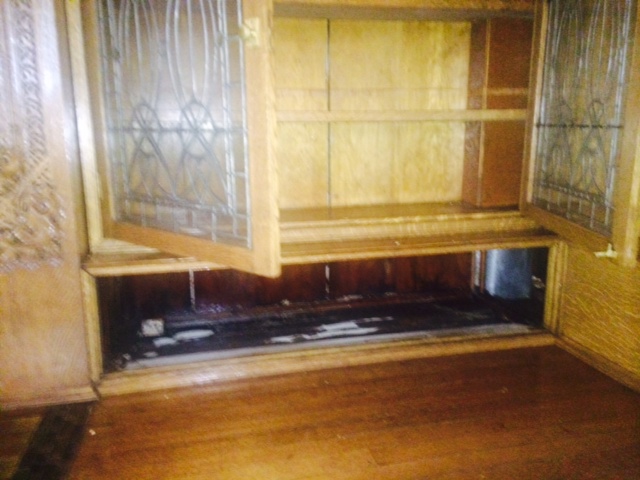
SAH staff tried to mitigate the flooding.  Once the flow of water stopped, staff members vacuumed up water from a storage room in the north side of the basement and the flooded powder room. Water had rushed down along the eastern wall of the library, onto Sullivan’s ornately carved fireplace surround and enclosed bookcases. The original white oak woodwork and wood floors were dried with rags and towels, but a portion of the ceiling, saturated with water, collapsed from the weight.

Plumbing professionals are on-site and found a blockage in a drainage pipe, which was likely the source of the backflow. SAH is assessing the damage and working with professionals to make repairs. Restoration architect John Eifler is advising SAH as it works to restore the damaged ceiling and walls of the house.  Professionals will help dry out the walls and ceiling before plaster and painting restoration can be undertaken.

HELP NEEDED
Cynthnia and Ben Weese have given SAH a $10,000 Challenge Grant for repairs and restoration of CPH. So, every dollar donated up to $10,000 will be matched from the grant.

PLEASE CONSIDER DOWNLOADING THE ATTACHED FORM AND MAKING A TAX-DEDUCTIBLE CONTRIBUTION TO THE RESTORATION.


SAH Chicago Chapter will provide periodic updates, including an estimate for restoration as the information is available.

4/12/10

Sullivan's Holy Trinity Church May 14th

Join City of Chicago cultural historian Tim Samuelson for an exclusive look at an architectural gem, Holy Trinity Orthodox Cathedral, 1903, Louis Sullivan Architect
Enjoy cocktails and hors d'oevres in the parish social hall with a lecture to follow in the sacred space.
Friday, May 14, 2010 at 6:30 p.m.
1121 N. Leavitt Street, Chicago
Complimentary parking available behind church building accessible via Haddon, east of Leavitt.
$50 suggested donation for Holy Trinity’s Building & Restoration Fund
Space is limited! RSVP by May 7th Leo@friendsofholytrinity.com or 773-728-1386
Wikipedia Excerpt Follows: Holy Trinity Orthodox Cathedral is the Cathedral Church of the Orthodox Church in America Diocese of the Midwest. It is one of only two churches designed by Louis Sullivan, one of the seminal architects of the 20th century.
It is listed on the US National Register of Historic Places and is designated a Chicago Landmark. The church was commissioned by the growing Russian congregation of Chicago, Illinois, and stands within the neighborhood known today as Ukrainian Village.
It remains one of only two Orthodox Churches servicing the orthodox community in Ukrainian Village. Construction work, partly financed by Tsar St. Nicholas II of Russia, lasted from 1899 to 1903. The church retains many features of the Russian provincial architecture, including an octagonal dome and a frontal belltower.
It is believed that the emigrants wished the church to be "remindful of the small, intimate, rural buildings they left behind in the Old World". Actually, the church would have passed unnoticed in the Russian countryside, if it were not for Sullivan's hallmark modern sensibility.
The cathedral's interior is based on the St Volodymyr's Cathedral in Kiev. The church was elevated to a cathedral in 1923, and stands today a member of the Orthodox community in Chicago.
Image courtesy HABS; Historic American Building Survey

1/11/09

DIALOGUES ON DESIGN: GUNNY HARBOE on THURSDAY, FEBRUARY 5, 2009


Sorry - This event is SOLD OUT
Join SAH - Chicago Chapter for advance notice and preferred reservations. Most of our events sold out last year! Don't miss out on 2009's roster of incredible adventures.
Click on the sidebar and download a membership form. Regular membership is just $25 for a full year of exclusive events, access and information!


IMPORTANT LOCATION CHANGE: THIS EVENT WILL BE HELD AT MADLENER HOUSE - 4 West Burton - NOT CHARNLEY HOUSE


Mr. Harboe’s intelligence as a Restoration Architect benefits dozens of masterpieces; Crown Hall, The Rookery, The Board of Trade, Carson Pirie Scott (Sullivan Center), Unity Temple, The Reliance, 860–880 Lake Shore Drive, The Marquette. The list goes on...at mid career, Gunny will share his insights & new work with members at Madlener House.

Thursday, February 5, 2009

5:30 Reception


6:00 Presentation followed by Q & A with Mr. Harboe


Gather at MADLENER HOUSE, 4 West Burton


SPACE IS LIMITED. RESERVE EARLY.


Preferably by email to sahchicago@gmail.com


Or to 708-358-1394


Members have priority for this event. Free for Members.

11/12/08

SAHCC SHOW & TELL AT CLIFF DWELLERS


Chicago Chapter Annual Show & Tell & Dinner
at The Cliff Dwellers Club

200 South Michigan Avenue, 22nd Floor Penthouse
Wednesday, December 3rd
Cocktails (cash bar) at 5:30 pm
Dinner at 6:30 pm - Program at 8 pm

CHOICE PRESENTER SLOTS OPEN!
In keeping with the Show and Tell tradition, presenters are asked to keep their slideshows to 8 minutes or under.
Both LCD and traditional slide projectors will be available along with a laptop loaded with Powerpoint and Microsoft.

Contact Bill Locke at 312-932-9790 with questions.

10/6/08

EVENT SOLD OUT: LOUIS SULLIVAN FILM PREVIEW AT GANZ HALL

THIS EVENT IS SOLD OUT. THANK YOU FOR YOUR INTEREST.

VISIT SOON FOR SAH CHICAGO CHAPTER EVENT UPDATES!

Column Capital in Roosevelt University's Ganz Hall. Photo: HABS 1963

The Society of Architectural Historians National and the Chicago Chapter invite you to a special preview excerpt of the documentary film Louis Sullivan: The Struggle for American Architecture.

When complete this film will be the first ever feature-length documentary devoted to Sullivan and the passionate struggle to preserve his buildings. The film includes sumptuous photography and important archival material.

Friday November 7th, 2008

In Sullivan’s masterpiece Ganz Hall at
Roosevelt University
430 South Michigan Avenue

Reception: 5:30 pm
Preview Excerpt: 6:15 pm
Discussion with Director
Mark Richard Smith 6:45 pm

FREE for SAH National and Chicago Chapter Members
$10 for non-members
$5 for students

Space is limited.

Please reserve early, preferably by email sahchicago@gmail.com or by calling 708-358-1394
Audio Visual services provided by Metronet Integration.

The National Organization Society of Architectural Historians and the Chicago Chapter are truly grateful to Roosevelt University and the Chicago Center for Performing Arts.

MORE ON RUDOLPH GANZ MEMORIAL HALL - FROM THE CHICAGO CENTER FOR PERFORMING ARTS AT ROOSEVELT UNIVERSITY WEBSITE FROM A STUDY BY BOOTH HANSEN ARCHITECTS:

Ganz Hall was originally conceived as a banquet hall for the Auditorium Hotel after the building had already been constructed in 1890. Louis Sullivan, the architect of the building, was faced with trying to build a new large space within the world's largest mixed-use high-rise building. The only area available for constructing a room for banqueting was above the Auditorium Theatre.

The two primary innovations of the project were to design a special support system for a two-story structure and bring about a refined space capable of formal dining. First, Sullivan worked closely with his partner and structural engineer, Dankmar Adler, to develop a system of iron trusses. The entire frame of the building was constructed to span across the top of the Theatre similar to the long spans of bridge design. This was the first innovation of the project.

The Banquet Hall, entered from the seventh floor of the hotel, is a fine example of the refinement of the ornamentation, the second innovation. Sullivan used a unique and distinctive system of ornamentation such as carved wood panels and capitals, stenciled wall patterns, elaborate plaster work, gilded lighting fixtures, and the use of Michigan birch and gold leaf - all of which made the interior striking. A young apprentice working for Sullivan, Frank Lloyd Wright, had obtained much responsibility at the time and designed some of the ornament.

The ornament is quite intricate and well-developed. The columns are large tapered-over scaled piers with rounded corners from which the ornament "appears" from the grain of the wood. The piers were a modern expression of the time because Sullivan stripped away all the traditional Victorian details in lieu of a simple oversized design.
Alterations

Around 1912, the Banquet Hall was used as a Masonic Lodge. The Masons made several alterations. The musicians' gallery at the north end of the hall was removed. A balcony was installed at the rear of the hall. They also sealed the center pair of doors, removed three of the stained glass windows, and painted the remaining windows black. The stencils were painted over and acoustical tiles were applied to the face of the beams.

In 1956, Chicago Musical College of Roosevelt University obtained the Hall. Many of the Masons' alterations were eliminated and the Hall was restored and converted to a recital hall. Under the direction of architect Crombie Taylor, the goal of restoring the room as closely as possible to the original ornamentation while providing an attractive hall for music recitals was begun. A stage and fixed theatre seating were installed to achieve this function. The majority of stencil patterns were recovered. Today, reproductions of the stencils remain on the back wall and in one of the arches as originally designed by Sullivan. However, some of the work that was planned, such as the stenciling on the beams and walls, and installing the ornamental light fixtures, was not completed at that time.

In 1980, architect John Vinci completed a project that helped control the environmental effects on the hall. A new roof and exterior wall system were installed along with new windows and skylights. Water that had been seeping into the Hall was eliminated. This was the beginning of keeping the Hall intact without further damage.

Work continues to restore the hall to its former splendor and provide adequately for use of the space as a recital hall. In 2001 the paintings lining the walls were removed and restored at the Art Institute. In the fall of 2002 the "electroliers" were recreated and installed, as well as a new HVAC system.

Ganz Hall history taken from a preliminary architectural report by Booth/Hansen & Associates, (c) 2004 Chicago College of Performing Arts.